Antenna Positioner Solutions: Improving Accuracy and Efficiency in RF Testing
Modern RF, EMC, EMI, antenna, and wireless testing environments require precise control over antenna location and orientation. Even a small change in antenna height, angle, or polarization can affect measurement results. For this reason, laboratories increasingly use automated positioning systems to achieve repeatable and controlled test configurations.
Antenna positioner solutions are designed to provide accurate movement and positioning of antennas during testing. They can help laboratories control antenna height, azimuth, elevation, polarization, or other required positioning parameters while reducing manual intervention.
For EMC and RF test facilities, the right positioning system is not simply a mechanical accessory. It is an important part of creating a controlled and repeatable testing environment.
JV Micronics designs and manufactures customized RF and EMC testing solutions, including antenna positioning systems developed around specific chamber and testing requirements.
What Are Antenna Positioner Solutions?
Antenna positioners are mechanical or motorized systems used to accurately move and position antennas during RF or EMC testing.
Depending on the application, a positioning system may provide:
- Vertical antenna height adjustment
- Horizontal or azimuth movement
- Elevation adjustment
- Antenna polarization control
- Remote or automated positioning
- Programmable movement
- Integration with chamber control systems
The configuration depends on the type of testing being performed and the requirements of the test facility.
In a conventional manual setup, technicians may need to reposition an antenna several times during a test. An automated antenna positioning system can make these movements more consistent and easier to control.
Why Are Antenna Positioning Systems Important in RF Testing?
RF measurements are highly dependent on test configuration. Antenna location, orientation, distance, and polarization can influence the measured field or received signal.
A positioning system helps maintain defined test parameters throughout the measurement process.
The key benefits include:
1. Improved Measurement Repeatability
Repeatability is an important consideration in laboratory testing. If an antenna is positioned differently during separate measurements, the resulting readings may vary even when the equipment under test has not changed.
Accurate positioning helps reduce unnecessary variation caused by manual adjustment.
2. Precise Antenna Height Adjustment
Many EMC test configurations require the antenna to be positioned at different heights.
A motorized antenna mast allows controlled vertical movement and can provide more consistent positioning than manual adjustment.
3. Controlled Antenna Orientation
Depending on the application, antennas may need to be rotated or adjusted to different orientations.
Automated positioning makes it easier to establish and reproduce predefined antenna positions.
4. Reduced Manual Intervention
Large testing chambers can make manual antenna adjustment inconvenient and time-consuming.
Remote-controlled positioning allows operators to make adjustments from a control area, reducing the need to repeatedly enter the chamber.
5. Better Testing Efficiency
When a test involves multiple antenna positions, automated movement can reduce setup time and simplify the overall workflow.
This becomes especially valuable in laboratories conducting frequent EMC, EMI, RF, or wireless measurements.
Where Are Antenna Positioners Used?
The appropriate positioning system depends on the testing application. Common applications include:
EMC and EMI Testing
In EMC laboratories, antennas may need to be positioned at different heights and orientations while measuring radiated emissions or conducting immunity evaluations.
An antenna mast or positioning system can provide controlled movement according to the test setup.
RF Testing
RF laboratories use antenna positioning systems for controlled measurement of transmitted and received signals.
Precise positioning can be particularly important when testing directional antennas or evaluating RF performance across different orientations.
Anechoic and Semi-Anechoic Chambers
Anechoic and semi-anechoic chambers often require controlled antenna movement as part of their test configuration.
Positioning systems can be integrated with other chamber equipment, such as turntables, monitoring systems, and control software.
Wireless Device Testing
Wireless and communication equipment may require measurements across different antenna orientations or positions.
Automated positioning can make these measurements more systematic and repeatable.
Antenna Characterization
Antenna testing may involve evaluating performance at different angles and positions. Positioning equipment can help provide the mechanical accuracy required for these measurements.
Key Components of an Antenna Positioning System
A reliable system typically combines mechanical, electrical, and control components.
Motorized Mast
The mast provides controlled vertical movement of the antenna. The required travel range depends on the chamber dimensions and testing methodology.
Drive Mechanism
A suitable motor and drive mechanism provide controlled movement. The selection depends on factors such as antenna weight, travel speed, positioning accuracy, and operating environment.
Rotation Mechanism
Some applications require antenna rotation around a vertical or horizontal axis. A suitable rotary mechanism can provide controlled angular positioning.
Control System
The control interface allows operators to move the antenna and establish defined positions.
Depending on the application, the system may support manual controls, remote operation, programmable sequences, or integration with laboratory automation.
Antenna Mounting Arrangement
The mounting system should accommodate the required antenna types while maintaining stable and repeatable positioning.
The mounting design may be customized according to antenna dimensions, weight, connector configuration, and chamber requirements.
Factors to Consider When Selecting Antenna Positioner
Not every positioning system is suitable for every RF or EMC laboratory. Several technical factors should be evaluated before selecting a solution.
1. Required Travel Range
The vertical or horizontal travel range should be sufficient for the intended test setup.
A system with inadequate travel may restrict testing, while excessive capacity can unnecessarily increase system complexity and cost.
2. Positioning Accuracy
The required accuracy depends on the testing application. The positioning mechanism should provide sufficiently controlled movement for the intended measurement procedure.
3. Antenna Weight and Dimensions
The system must safely support the antennas being used. Mechanical capacity should account for antenna weight, mounting hardware, cables, and movement dynamics.
4. Speed of Movement
Testing facilities may have different requirements for positioning speed. A laboratory conducting frequent automated measurements may benefit from faster controlled movement, while other applications may prioritize precision over speed.
5. Control and Automation
A modern test laboratory may require integration with existing control software or automated test sequences.
Before selecting a positioning system, it is important to determine whether the system needs basic remote control or more advanced programmable operation.
6. Chamber Compatibility
The antenna positioner solutions should be designed to work within the physical and electromagnetic requirements of the chamber.
Mounting locations, cable routing, available space, absorber placement, and chamber access all need to be considered.
7. Maintenance and Serviceability
A positioning system is part of a long-term laboratory investment. Components should be accessible for maintenance, and the overall design should support reliable operation over repeated test cycles.
Antenna Positioners and EMC Test Standards
EMC testing should always be performed according to the applicable product and test standards. Standards can define specific requirements for test distances, antenna arrangements, measurement configurations, field levels, and other parameters.
The IEC 61000 series covers many electromagnetic compatibility test methods, while product-specific standards may establish additional requirements depending on the equipment being evaluated.
A positioning system should therefore be selected as part of the overall test-facility design rather than independently of the applicable testing methodology.
The correct configuration helps laboratories establish controlled and repeatable antenna positions that are appropriate for their specific testing requirements.
Manual vs. Automated Antenna Positioning
Both manual and automated systems can have a place in testing environments, but they serve different operational requirements.
Manual positioning can be suitable for smaller facilities with limited testing frequency. However, repeated manual adjustments may increase setup time and introduce positioning inconsistencies.
Automated antenna positioner solutions provide controlled movement and can reduce repetitive manual work. They are particularly useful for laboratories where multiple positions, frequent testing, or automated test sequences are required.
The right choice depends on the laboratory’s test volume, chamber design, accuracy requirements, automation objectives, and budget.
Benefits of Customized Antenna Positioner Solutions
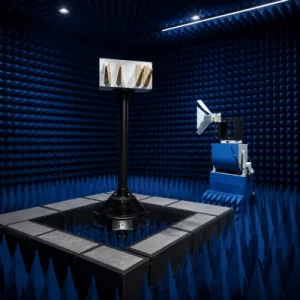 A standard positioning system may not always suit a specialized chamber or testing application.
Customization can address requirements such as:
- Specific antenna dimensions
- Required travel height
- Custom mounting arrangements
- Special chamber geometry
- Automated movement sequences
- Remote operation
- Integration with existing test systems
- Specific load and positioning requirements
A customized solution can therefore provide a better fit between the mechanical positioning system and the overall testing environment.
Why Choose JV Micronics?
JV Micronics is an antenna positioner manufacturer, supplier, and provider focused on customized solutions for RF, EMC, EMI, and specialized testing environments.
We understand that positioning requirements can vary significantly between laboratories. Our approach is based on understanding the application first and then developing a solution around the chamber configuration and testing objectives.
JV Micronics can support requirements involving:
- Motorized antenna masts
- Antenna positioning systems
- RF and EMC chamber integration
- Customized mechanical positioning
- Remote-controlled positioning
- Test facility automation
- Specialized chamber accessories
Our engineering approach considers factors such as movement range, antenna load, positioning requirements, chamber dimensions, control requirements, and integration with the wider testing environment.
How JV Micronics Helps With Antenna Positioner Solutions
JV Micronics provides customized antenna positioner solutions designed to support accurate and repeatable antenna movement within RF and EMC testing environments.
Our team can evaluate the testing requirement, chamber layout, antenna specifications, required movement, and control preferences before developing an appropriate configuration.
From design and manufacturing to installation and integration, the objective is to provide a positioning system that works as part of the complete test facility.
For laboratories developing a new EMC chamber, upgrading an existing facility, or requiring specialized antenna movement equipment, JV Micronics can help create a solution aligned with the technical requirements of the application.
Conclusion
Accurate antenna positioning is an important part of creating a reliable RF and EMC testing environment. Variations in antenna height, orientation, or position can affect measurements, making controlled movement essential for applications that require repeatability.
A well-designed antenna positioner solutions can improve positioning accuracy, reduce manual intervention, increase testing efficiency, and support integration with automated laboratory workflows.
The best solution depends on the chamber configuration, antenna specifications, movement requirements, applicable testing standards, and level of automation required.
By working with an experienced antenna positioner manufacturer, laboratories can develop a positioning system that is designed around their actual testing environment rather than relying on a generic configuration.