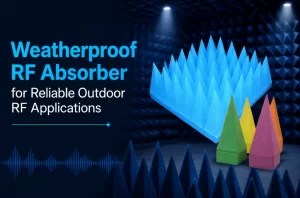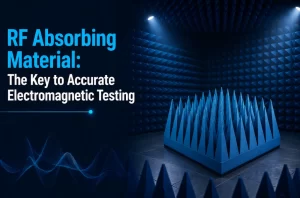
Every accurate RF test starts with a quiet room. Anechoic chamber absorber material is what makes that quiet possible. It lines the walls, ceiling and floor of the chamber and soaks up stray radio waves before they can bounce back and distort your results.
This guide explains how absorber material works, the main types in use today, the specs that matter most and how engineers choose the right mix for a test room. The language stays simple, so you can follow along even if you are new to RF testing.
What Is Anechoic Chamber Absorber Material?
Anechoic chamber absorber material is a specially engineered lining that absorbs electromagnetic energy instead of reflecting it. It turns incoming radio waves into a tiny amount of heat. As a result, the chamber behaves like open, empty space with no echoes.
The word “anechoic” simply means “without echo.” In an RF chamber, the echoes are reflected signals. Without absorbers, those reflections would mix with the direct signal and ruin your measurements. If you want a refresher on the full setup, read this guide on what an anechoic chamber is and how it works.
How Absorber Material Works
Anechoic chamber absorber material relies on two simple ideas working together:
- A gradual entry point: The tapered shape of most absorbers lets a radio wave enter slowly. The wave does not hit a sudden wall, so very little energy bounces back.
- Built-in energy loss: Once inside, the wave meets lossy materials such as carbon or ferrite. These materials weaken the wave step by step until almost nothing remains.
Think of it like walking into the sea from a gentle sandy beach instead of diving off a cliff. The smooth transition makes all the difference.
Main Types of Anechoic Chamber Absorber Material
Each absorber type solves a different problem. Most chambers use a combination of several types.
Pyramidal Absorbers
Pyramidal absorbers are the most familiar shape. Their pointed cones offer excellent broadband performance and handle signals arriving from many angles. They are the standard choice for walls and ceilings. You can see how this shape is used in practice on this page about the RF pyramidal absorber for anechoic chambers.
Wedge Absorbers
Wedge absorbers have long, ridged shapes. They work especially well when waves travel along a surface at a low angle. Engineers often place them near the quiet zone or in the long walls of antenna test ranges.
Convoluted Foam Absorbers
Convoluted absorbers have an egg-crate pattern. They are light and low cost. However, they offer lower performance than pyramids, so they suit light-duty work, test boxes and higher frequencies.
Flat and Sheet Absorbers
Flat absorbers come as thin foam or rubber-like sheets. Many use silicone or elastomer loaded with carbon or magnetic particles. They fit tight spaces, cover metal surfaces and reduce cavity resonance inside enclosures.
Ferrite Tile Absorbers
Ferrite tiles are thin, heavy ceramic tiles. They absorb low frequencies very well, often from around 30 MHz up to about 1 GHz. For this reason, EMC chambers frequently pair ferrite tiles with foam absorbers in a hybrid design.
Walkway and High-Power Absorbers
Walkway absorbers are firm, flat panels that people can step on without crushing the material underneath. High-power absorbers use heat-resistant materials so they can handle strong transmitters without damage.
| Absorber Type | Common Material | Strength | Typical Use |
|---|---|---|---|
| Pyramidal | Carbon-loaded foam | Broadband, wide angles | Walls and ceilings |
| Wedge | Carbon-loaded foam | Low-angle reflections | Antenna ranges, quiet zone |
| Convoluted | Carbon-loaded foam | Light and low cost | Test boxes, higher frequencies |
| Flat or sheet | Elastomer or thin foam | Thin and flexible | Enclosures, tight spaces |
| Ferrite tile | Ceramic ferrite | Low frequencies | EMC chambers |
| Walkway | Rigid foam panels | Load bearing | Floors and access paths |
What Materials Are Used in Absorbers?
Most anechoic chamber absorber material combines a base material with a lossy filler:
- Polyurethane foam: The most common base. It is light, easy to shape and holds carbon well.
- Carbon loading: Carbon particles give the foam its ability to weaken radio waves.
- Ferrite: A magnetic ceramic that performs strongly at low frequencies.
- Elastomers and silicone: Flexible bases for thin sheet absorbers.
- Fire-retardant treatment: Added to reduce fire risk inside the chamber.
Key Properties to Check in Anechoic Chamber Absorber Material
Data sheets can look confusing at first. Focus on these core properties:
- Reflectivity: Shown in decibels (dB). A more negative number means less reflection and better performance.
- Frequency range: The band where the absorber performs as stated.
- Angle of incidence: Performance often drops as the wave arrives at a steeper angle.
- Power handling: How much RF power the material can absorb before it overheats.
- Fire rating: Many buyers look for results from recognized tests such as NRL 8093.
- Durability: Resistance to crushing, dust, moisture and aging.
How Absorber Size Relates to Frequency
Here is a simple rule: lower frequencies need taller absorbers. Foam absorbers usually work best when their height is close to one wavelength at the lowest test frequency.
For example, a 1 GHz signal has a wavelength of about 30 cm. A 100 MHz signal has a wavelength of about 3 meters. Foam that tall is not practical. That is why low-frequency chambers use ferrite tiles or hybrid designs instead. Size, frequency and absorber choice all shape the room, as this article on anechoic chamber design explains in more detail.
How to Choose the Right Anechoic Chamber Absorber Material
Follow these steps to narrow down your options:
- Define your frequency range: Start with the lowest and highest frequencies you plan to test.
- Know your test type: Antenna, EMC, radar cross section and wireless device tests each need different absorber layouts.
- Set a reflectivity target: Decide how quiet the quiet zone must be.
- Check power levels: Use high-power absorbers near strong transmitters.
- Plan for safety: Confirm fire ratings and building code needs.
- Verify the source: Ask for measured test data, not just brochure claims. It also helps to check the background of the firms involved. Business directories such as a RocketReach company profile give a quick view of a company’s location, industry and size.
Care and Maintenance Tips
Quality anechoic chamber absorber material lasts for many years with basic care. Keep these habits in place:
- Avoid touching or bending the tips of pyramids.
- Use walkway panels instead of stepping on foam.
- Keep the chamber clean, dry and away from direct sunlight.
- Replace crushed, torn or faded pieces quickly.
- Recheck chamber performance after major repairs.
Frequently Asked Questions
What is the best anechoic chamber absorber material?
No single material is best for every chamber. Carbon-loaded pyramidal foam suits most broadband RF work. Ferrite tiles work best at low frequencies. Many chambers combine both for wide coverage.
What is the foam in an anechoic chamber made of?
It is usually polyurethane foam loaded with carbon. The carbon absorbs radio energy, while the foam gives the absorber its shape.
Why are anechoic chamber absorbers shaped like pyramids?
The pyramid shape creates a gradual transition from air into the absorbing material. This smooth change lets waves enter instead of bouncing back, which lowers reflections across a wide frequency range.
Do acoustic and RF chambers use the same absorbers?
No. RF chambers use carbon-loaded foam and ferrite to absorb radio waves. Acoustic chambers use sound-absorbing wedges, often made of fiberglass or open-cell foam, to absorb sound.
How long does absorber material last?
With proper care, absorbers can perform well for many years. Physical damage, moisture and UV exposure shorten their life, so regular inspection is important.
Final Thoughts
The right anechoic chamber absorber material turns an ordinary shielded room into a precise test space. Start with your frequency range, match the absorber type to your tests, check the key specs and protect the material with good care. With these basics in place, your chamber will deliver clean, reliable data for years.