When engineers need to evaluate antenna performance accurately, conventional far-field testing is not always practical. Large test distances, space limitations, environmental interference, and the physical size of antennas can make traditional testing difficult.
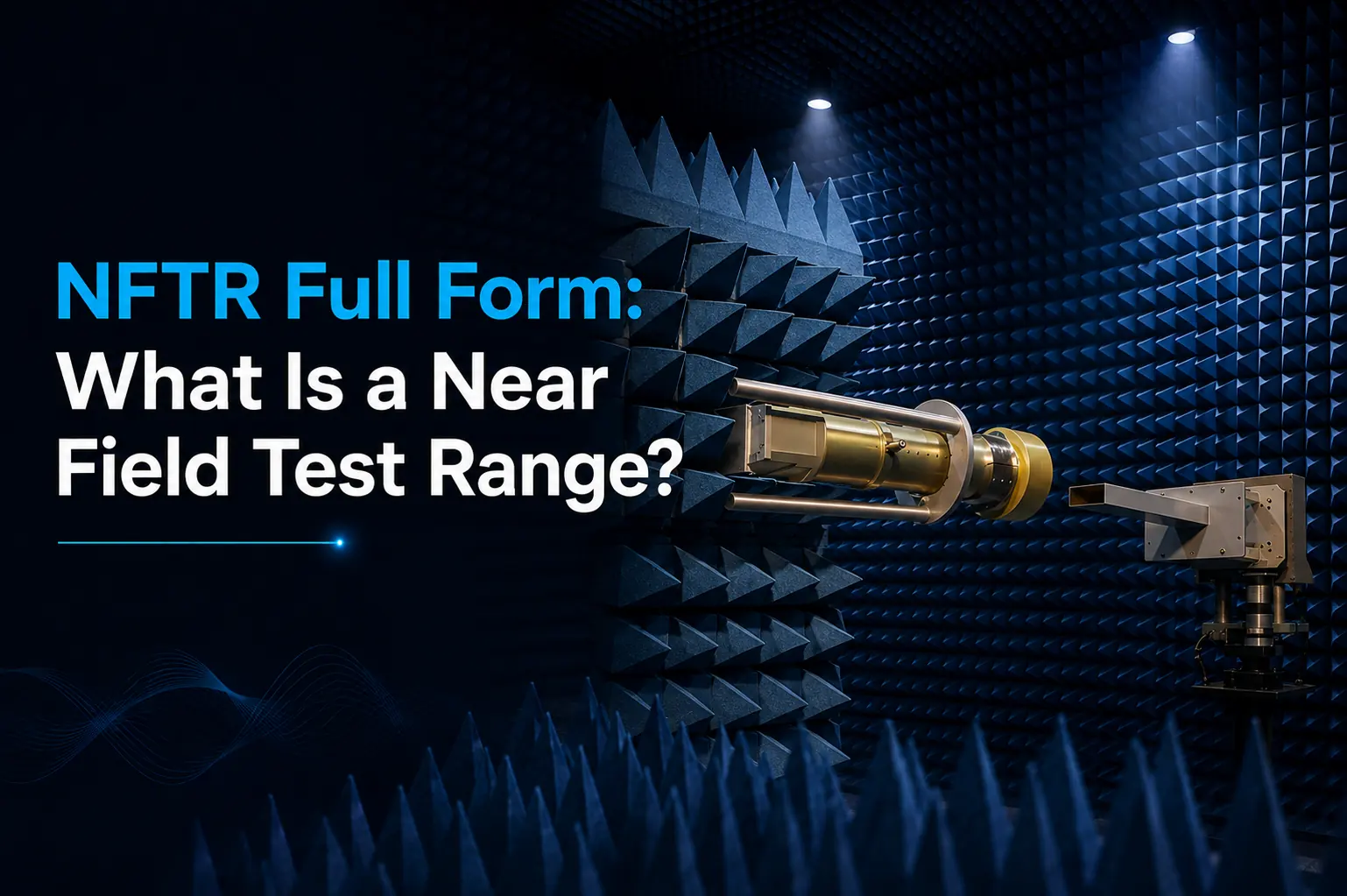
The NFTR full form is Near-Field Test Range. It is an advanced antenna measurement facility in which electromagnetic fields are measured relatively close to the antenna under test and then mathematically processed to determine its far-field characteristics.
NFTR systems are widely relevant to antenna development and characterization across telecommunications, aerospace, defense, radar, satellite communication, research, and emerging wireless technologies.
What Is the NFTR Full Form?
The NFTR full form is Near-Field Test Range. It is designed to measure the electromagnetic field around an Antenna Under Test, commonly referred to as the AUT, without requiring the long separation distance normally needed for direct far-field measurements.
Instead of measuring only the antenna’s far-field radiation directly, an NFTR captures detailed amplitude and phase information within the antenna’s near-field region.
Specialized software then applies a near-field-to-far-field transformation to calculate the antenna’s expected far-field characteristics.
3GPP documentation describes NFTR measurement techniques involving amplitude and phase measurements over surfaces such as planar, cylindrical, and spherical geometries, followed by computerized processing of the measurement data.
How Does a Near-Field Test Range Work?
A typical NFTR system combines precision mechanical positioning, RF instrumentation, probe antennas, motion control, data acquisition, and measurement software.
The basic measurement process can be understood in five stages.
1. Positioning the Antenna Under Test
The antenna being evaluated is installed at a defined position inside the test environment.
Correct alignment and positioning are important because mechanical errors can affect measurement accuracy.
2. Near-Field Scanning
A calibrated probe antenna measures the electromagnetic field around the AUT.
The probe moves through a predefined scanning geometry while collecting field information at multiple measurement points.
3. Amplitude and Phase Measurement
At each measurement position, the system records important RF parameters, particularly the amplitude and phase of the electromagnetic field.
Accurate amplitude and phase measurement allows the system to reconstruct the antenna’s radiation behavior.
4. Near-Field to Far-Field Transformation
Once the near-field data has been collected, mathematical algorithms convert the measurements into far-field information.
This process is known as near-field to far-field transformation, or NF-to-FF transformation.
3GPP describes this transformation as a mathematical computation applied to measured near-field radiation patterns to obtain corresponding far-field radiation characteristics.
5. Antenna Performance Analysis
The processed data can then be used to evaluate antenna characteristics such as:
- Radiation pattern
- Antenna gain
- Directivity
- Beam characteristics
- Polarization
- Sidelobe behavior
- EIRP in applicable measurement configurations
The exact measurements available depend on the NFTR configuration, instrumentation, antenna type, frequency range, and testing requirements.
Main Types of Near-Field Antenna Measurement
Near-field measurement systems are generally classified according to the geometry used during scanning.
Planar Near-Field Measurement
In a planar system, the probe moves across a flat measurement plane in front of the antenna.
Planar scanning is particularly suitable for antennas with highly directional radiation characteristics, including many aperture and array antenna designs.
Cylindrical Near-Field Measurement
A cylindrical NFTR collects measurement data around the antenna across a cylindrical surface.
This configuration can be useful where radiation characteristics need to be evaluated across a wider angular region around the antenna.
Spherical Near-Field Measurement
In spherical near-field measurement, data is collected across a spherical surface surrounding the antenna.
This approach can provide comprehensive three-dimensional antenna characterization and is particularly useful where radiation needs to be evaluated over a large angular coverage.
IEEE’s near-field measurement guidance identifies planar, cylindrical, and spherical geometries as the principal near-field measurement approaches.
Why Is NFTR Used for Antenna Testing?
One of the most important advantages of a Near-Field Test Range is that the antenna does not have to be positioned at the full conventional far-field measurement distance.
This can substantially reduce the physical space required for certain antenna measurement facilities.
Other potential advantages include:
Controlled Measurement Environment
NFTR facilities are commonly implemented within carefully designed indoor test environments, helping reduce unwanted external signals and electromagnetic reflections.
Detailed Antenna Characterization
Near-field scanning collects amplitude and phase information at many measurement points, providing detailed data for antenna analysis.
Reduced Measurement Distance
Because mathematical transformation is used to calculate far-field characteristics, the physical measurement distance can be considerably shorter than that required by conventional direct far-field testing.
Suitable for Advanced Antenna Systems
Near-field measurement techniques can be applied to sophisticated antenna systems used in areas such as:
- Radar
- Satellite communication
- Aerospace
- Defense
- 5G communication
- Antenna arrays
- Research and development
- Wireless communication systems
NFTR and Industrial Antenna Measurement Practices
Accurate antenna testing requires more than installing a scanner and RF equipment. Mechanical positioning accuracy, probe calibration, reflections, RF leakage, amplitude and phase stability, measurement distance, data processing, and measurement uncertainty can all influence the final results.
Important industry references related to antenna and near-field measurements include IEEE 149-2021, which provides general recommended practices for antenna measurements, and IEEE 1720-2012, which specifically addresses near-field antenna measurement practices. IEEE currently classifies IEEE 1720-2012 as Inactive-Reserved while its P1720 revision project remains active.
For applicable telecommunications and base-station OTA measurements, 3GPP TR 37.941 also describes Near Field Test Range measurement systems, calibration, procedures, and measurement uncertainty considerations.
The exact standards and test procedures applicable to an NFTR project should therefore be determined according to the antenna, frequency range, industry, measurement objective, and compliance requirements.
NFTR vs Far-Field Test Range
Both NFTR and far-field ranges are used for antenna characterization, but their measurement principles differ.
A conventional far-field range measures antenna characteristics at a distance where the electromagnetic wave has reached the required far-field conditions.
An NFTR collects electromagnetic field information closer to the antenna and applies mathematical processing to derive the corresponding far-field characteristics.
Therefore, choosing between an NFTR, conventional far-field range, Compact Antenna Test Range, or another antenna measurement configuration depends on factors such as:
- Antenna dimensions
- Operating frequency
- Required measurement accuracy
- Available facility space
- Measurement parameters
- Test environment
- Budget
- Current and future testing requirements
There is no single antenna test range configuration that is ideal for every application.
How JV Micronics Helps With Near-Field Test Range Solutions
Once the NFTR full form and working principle are understood, the next important step is designing a test facility around the actual antenna measurement requirement.
JV Micronics is a Near-Field Test Range manufacturer and antenna testing solution provider offering precision-engineered NFTR systems for RF and microwave antenna measurements.
JV Micronics provides solutions for planar, cylindrical, and spherical near-field measurements and positions its NFTR systems for applications including radar, satellite, 5G, IoT, telecommunications, aerospace, defense, and research. The company also provides support covering system design, installation, software integration, training, and after-sales requirements.
Depending on the project, an NFTR solution may require integration of RF absorbers, antenna positioning systems, measurement instrumentation, scanners, control systems, software, and the overall RF testing environment.
JV Micronics works with customers to understand these requirements and develop a customized solution rather than applying the same test-range configuration to every application. Explore JV Micronics’ Near-Field Test Range (NFTR) solutions for more information.
Conclusion
The Near-Field Test Range represents an important approach to modern antenna measurement where electromagnetic fields are captured near the antenna and processed to determine far-field characteristics.
With planar, cylindrical, and spherical measurement possibilities, NFTR technology provides engineers with a practical way to perform detailed antenna characterization while avoiding some of the physical-distance requirements associated with conventional far-field ranges.
However, the effectiveness of an NFTR depends on correct system design, mechanical precision, calibration, RF performance, measurement software, and proper integration of the complete testing environment.
For organizations planning a new antenna measurement facility, working with an experienced NFTR manufacturer can help ensure that the system is designed around the antenna size, frequency range, measurement objectives, available space, and future testing requirements.