Choosing an antenna measurement chamber manufacturer is one of the biggest decisions an RF lab can make. The chamber shapes the accuracy of every radiation pattern, gain value and efficiency result you record for years. So it pays to know what to look for before you compare quotes.
This guide explains what an antenna measurement chamber is, how the main chamber types differ, and which checks separate a reliable builder from a risky one. It is written for engineers, lab managers and buyers who want clear, practical answers.
What Is an Antenna Measurement Chamber?
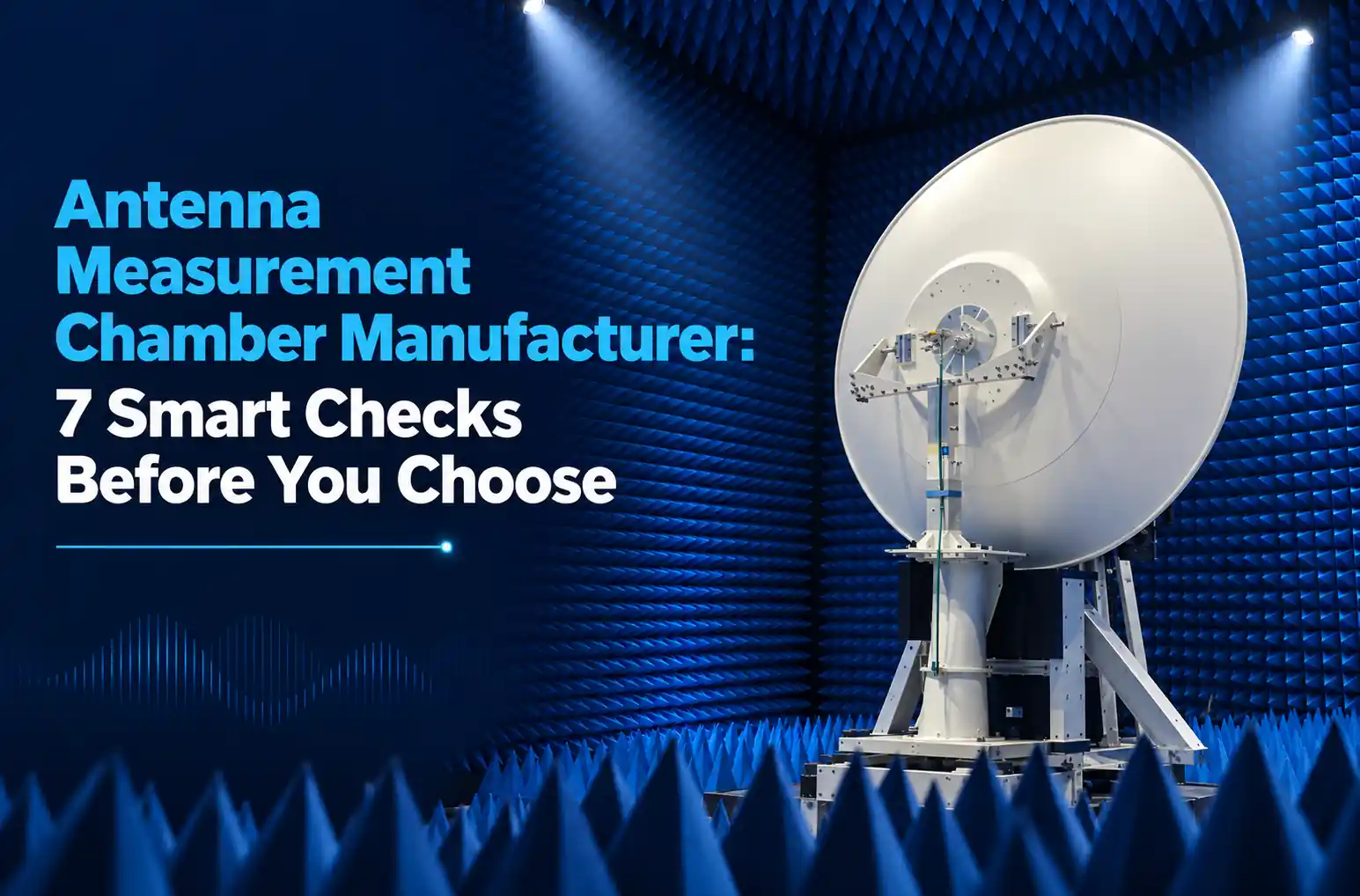
An antenna measurement chamber is a shielded room lined with RF absorbing material. The shielding blocks outside signals. The absorbers stop reflections inside the room. Together, they create a quiet, echo-free space where engineers can measure exactly how an antenna sends and receives energy.
Most chambers include these core parts:
- Shielded enclosure: Metal panels, usually steel or copper, that keep outside interference out.
- RF absorbers: Pyramidal foam, wedges or ferrite tiles that soak up stray signals.
- Positioner: A motorized system that rotates the antenna under test to precise angles.
- Range or probe antenna: A reference antenna that transmits or receives the test signal.
- Instruments and software: A vector network analyzer (VNA) and control software that capture and process the data.
For a closer look at each instrument, see this overview of the main antenna testing equipment used in RF labs.
Main Types of Antenna Measurement Chambers
Not every chamber works the same way. The right type depends on your antenna size, frequency range and available floor space.
Far-Field Chambers
A far-field chamber measures the antenna directly at a long enough distance for the signal to behave like a flat wave. A common rule of thumb sets that distance at 2D²/λ, where D is the antenna size and λ is the wavelength. As a result, far-field rooms work best for small antennas or lower frequencies.
Near-Field Chambers
A near-field chamber scans the signal very close to the antenna. It then uses math to calculate the far-field pattern. Scans can follow planar, cylindrical or spherical paths. This approach saves a lot of space. You can learn more in this guide to the near-field test range (NFTR).
Compact Antenna Test Range (CATR)
A CATR uses a precision reflector to turn a spherical wave into a flat plane wave over a short distance. This makes it a strong choice for large antennas, satellite payloads and millimeter-wave devices such as 5G modules.
| Chamber Type | How It Works | Best For | Space Needed |
|---|---|---|---|
| Far-field | Direct measurement at long range | Small antennas, lower frequencies | Large |
| Near-field | Close scan plus math transform | Wide range of antennas, limited space | Small to medium |
| CATR | Reflector creates a plane wave | Large antennas, mmWave, 5G | Medium |
Why the Choice of Antenna Measurement Chamber Manufacturer Matters
A chamber is only as good as its design and build quality. Small mistakes create big problems. For example, gaps between absorbers, weak door seals or a poorly aligned positioner can all add unwanted reflections. These errors show up as ripple in your test data.
Bad data leads to retests, delayed product launches and failed certifications. That is why the skills of the antenna measurement chamber manufacturer matter just as much as the price tag.
7 Smart Checks for Evaluating an Antenna Measurement Chamber Manufacturer
Use these seven checks to compare suppliers fairly and spot weak proposals early.
1. RF Design and Simulation Skills
Ask how the builder predicts chamber performance before construction starts. Strong teams use electromagnetic simulation or ray-tracing tools to plan absorber layout and room size. They should explain their design choices in plain terms.
2. Absorber Quality and Frequency Range
Absorbers decide how quiet your chamber will be. Ask for reflectivity values in decibels (dB) at your key test frequencies. Lower frequencies need taller absorbers or ferrite tiles. Also, check the fire safety rating of the foam.
3. Quiet Zone Performance
The quiet zone is the area where the antenna sits during testing. It must have the lowest possible reflections. Ask for the quiet zone size and its reflectivity level. Most importantly, ask whether these numbers are measured on site or only predicted.
4. Shielding Effectiveness
Shielding effectiveness shows how well the room blocks outside signals, measured in dB across a frequency range. Doors, vents, power filters and cable panels are common weak points. A reliable antenna measurement chamber manufacturer tests shielding using recognized methods such as IEEE 299.
5. Positioner and System Integration
The positioner, instruments and software must work as one system. Check positioner accuracy, load capacity and speed. Also, confirm that the software supports your VNA and the measurements you need, such as gain, directivity and axial ratio.
6. Standards and Validation
Good builders follow established test practices, such as IEEE 149 for antenna measurement procedures. Ask for a clear acceptance test plan. You should receive full documentation of the final results before you sign off.
7. Installation, Calibration and Long-Term Support
A chamber can serve your lab for decades. So support matters. Ask whether the antenna measurement chamber manufacturer offers site surveys, on-site installation, staff training, spare absorbers and scheduled recalibration. Clear warranty terms also protect your investment.
To see how these features come together in a finished facility, explore this page on antenna measurement chamber solutions.
How to Research a Manufacturer Before You Buy
A polished proposal does not always mean a proven antenna measurement chamber manufacturer. Follow these simple steps to verify any supplier:
- Review past projects: Ask for case studies that match your frequency range and chamber type.
- Request references: Speak with labs that have used the chamber for a few years.
- Check the company background: Public business directories list basic details such as location, industry focus and team size. For example, you can review a RocketReach company profile to understand a firm’s scale and history.
- Visit a working installation: Seeing a live chamber reveals build quality that brochures cannot.
- Compare proposals line by line: Match absorber specs, quiet zone data and support terms, not just the total price.
Common Mistakes to Avoid
Even with a skilled antenna measurement chamber manufacturer, buyers can make costly planning errors. Watch out for these:
- Buying on price alone: Cheap chambers often cost more in retests and upgrades.
- Ignoring future needs: Plan for higher frequencies, such as mmWave bands used in 5G and emerging 6G research.
- Undersizing the room: A small chamber limits the antennas you can test later.
- Skipping acceptance testing: Always verify performance before final payment.
- Forgetting building services: Ventilation, lighting and fire safety must fit the shielded design.
Industries That Rely on Antenna Measurement Chambers
Many sectors depend on accurate antenna data:
- Aerospace and defense: Radar, satellite and navigation antennas.
- Telecommunications: 5G base stations, smartphones and small cells.
- Automotive: Radar sensors and vehicle-to-everything (V2X) antennas.
- IoT and wearables: Compact antennas in smart devices.
- Medical devices: Wireless implants and patient monitors.
Frequently Asked Questions
What does an antenna measurement chamber manufacturer do?
An antenna measurement chamber manufacturer designs, builds, installs and validates shielded test rooms for antenna testing. The work usually covers RF design, absorber supply, shielding, positioners, software integration and final performance testing.
How much does an antenna measurement chamber cost?
Cost varies widely. The main factors are chamber size, frequency range, chamber type, absorber grade, positioner capability and software. A small benchtop near-field system costs far less than a large CATR facility.
What frequency range can an antenna chamber cover?
Many chambers cover a few hundred MHz up to tens of GHz. Chambers built for millimeter-wave testing can reach much higher frequencies. The absorber design sets the lower limit.
What is the difference between near-field and far-field testing?
Far-field testing measures the antenna directly at a long distance. Near-field testing scans close to the antenna and calculates the far-field pattern with math. Near-field setups need much less space.
How long does it take to build an antenna measurement chamber?
Timelines depend on size and complexity. Simple chambers can take a few months. Large or custom facilities take longer because of design, fabrication, installation and validation steps.
Final Thoughts
An antenna chamber is a long-term investment in data quality. Focus on proven RF design, measured quiet zone results, strong shielding and dependable support. When you apply these seven checks, you can choose an antenna measurement chamber manufacturer with confidence and build a lab that delivers accurate results for years to come.