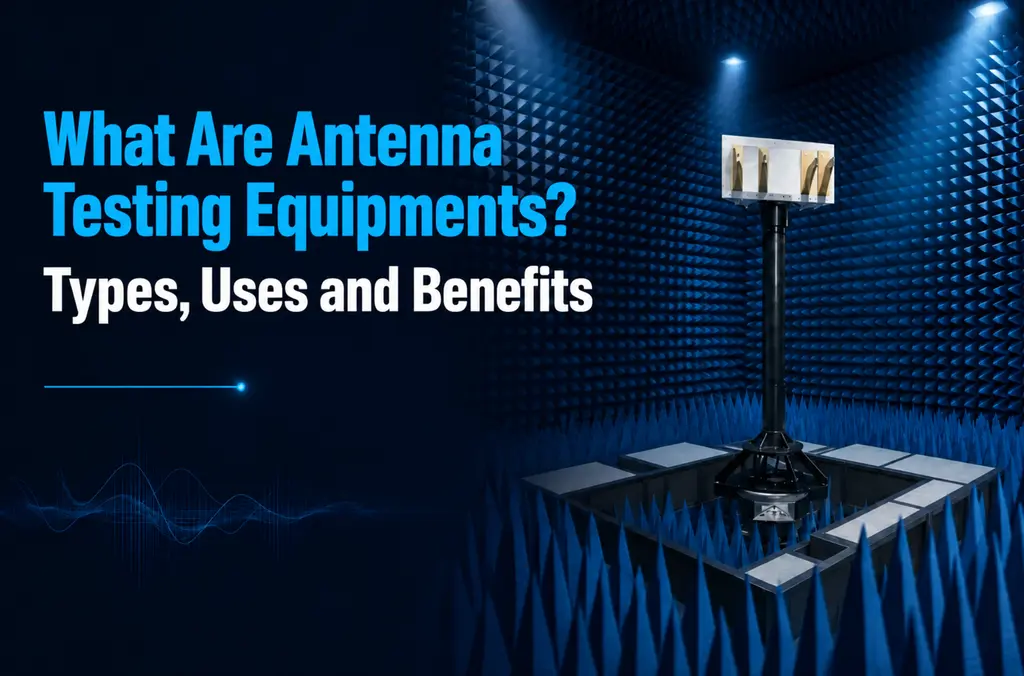
Antenna testing equipment refers to the instruments, test systems and controlled environments used to measure how an antenna transmits and receives radio-frequency signals. These systems help engineers confirm that an antenna meets its required specifications before it is used in telecom, defence, aerospace, satellite communication, automotive radar or connected devices.
An antenna must deliver the intended signal strength, direction and frequency response. A small design variation, poor matching or unwanted reflection can reduce coverage and affect the reliability of an entire wireless system. Accurate antenna testing equipment helps identify such issues early, so manufacturers can improve performance before installation or delivery.
Why Is Antenna Testing Equipment Important?
Antenna testing provides reliable, measurable data rather than depending on assumptions from a design simulation. Engineers use it to verify gain, radiation pattern, bandwidth, efficiency, impedance and polarisation. These results show whether the antenna will perform correctly in its real application.
- Confirm antenna performance against design requirements
- Measure signal strength, coverage direction and beamwidth
- Detect impedance mismatch, signal loss and unwanted radiation
- Compare prototype and production-unit performance
- Support quality control, compliance testing and product development
This is particularly important in high-frequency and mission-critical applications. For example, a radar antenna needs dependable directional performance, while a satellite communication antenna requires precise gain and polarisation characteristics for stable links.
Main Types of Antenna Testing Equipment
Vector Network Analyzer
A Vector Network Analyzer, or VNA, is a core instrument in antenna measurement. It evaluates how the antenna responds to an RF signal and is commonly used to measure return loss, VSWR, impedance, resonant frequency, bandwidth and S-parameters.
These measurements help determine whether the antenna is properly matched to its RF circuit. When matching is poor, some transmitted power is reflected back instead of being radiated efficiently.
Spectrum Analyzer
A spectrum analyzer displays RF signals across a selected frequency range. It helps engineers examine signal level, harmonics, spurious emissions and possible interference. This makes it useful for evaluating transmitting antennas and wireless devices that must operate within a defined frequency band.
Antenna Measurement System
An antenna measurement system combines RF instruments, a transmitting or receiving reference antenna, cables, software and a controlled test range. It is used to measure gain, radiation pattern, directivity, beamwidth, side lobes and cross-polarisation.
The setup may be configured for far-field or near-field measurement, depending on the antenna size, frequency and test objective. For a detailed explanation of near-field testing, read our guide on what a Near Field Test Range is.
Antenna Positioners
Antenna positioners accurately rotate and move the antenna during testing. They allow the system to collect measurements across different azimuth and elevation angles, which is essential for generating a complete radiation pattern.
Positioners are available for compact wireless-device antennas as well as heavy defence, radar and satellite antennas. Learn more about how antenna positioner solutions improve RF testing accuracy.
Role of Anechoic Chambers in Antenna Testing
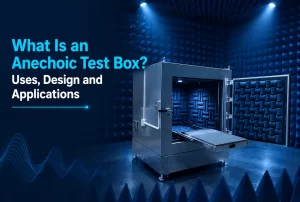
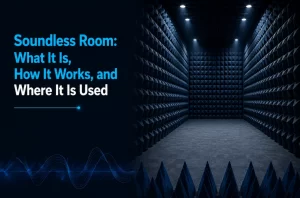
Many precise antenna measurements are carried out inside an RF anechoic chamber. The chamber is designed to limit outside electromagnetic interference and absorb internal RF reflections. This creates a controlled environment where the measured signal comes primarily from the antenna under test.
RF absorbing materials on the chamber walls, ceiling and floor reduce reflections that could otherwise distort radiation-pattern and gain measurements. Explore our guide on how an anechoic chamber works and understand the role of RF absorbing materials in accurate electromagnetic testing.
Where Is Antenna Testing Equipment Used?
Antenna testing equipment is used in industries where reliable wireless performance matters. Common applications include mobile communication, 5G infrastructure, Wi-Fi and IoT devices, defence communication, electronic warfare, aerospace, satellite systems, automotive radar, navigation and broadcast equipment.
The equipment and test range must be selected according to the frequency range, antenna size and weight, required accuracy, measurement distance and level of automation needed. A small IoT antenna may use a compact test setup, while a large radar antenna can require a sophisticated chamber and high-capacity positioner.
Choose the Right Antenna Testing Solution
When selecting antenna testing equipment, look beyond individual instruments. The complete solution should support the required frequency band, measurement method, antenna dimensions and reporting needs. A properly designed system helps shorten development cycles, improve product consistency and provide trustworthy measurement results.
JV Micronics provides customised antenna testing solutions, including antenna measurement systems, positioners, RF anechoic chambers and test-range equipment. Our engineering team can help you select and configure the right system based on your frequency range, antenna size, measurement accuracy and application requirements.