Soundless Room: What It Is, How It Works, and Where It Is Used
Accurate testing often requires an environment where unwanted noise, echoes, and reflections are controlled. In a normal room, sound waves bounce off walls, ceilings, floors, and other hard surfaces. These reflections can affect measurements and make it difficult to evaluate the actual performance of a product or component.
A soundless room, commonly known as an anechoic chamber, is designed to minimize these reflections and create a highly controlled testing environment. It is used in industries where accurate acoustic measurements and product performance testing are important.
From electronics and automotive components to aerospace systems and consumer products, these specialized rooms allow engineers and researchers to measure sound and other performance characteristics with greater accuracy.
What Is a Soundless Room?
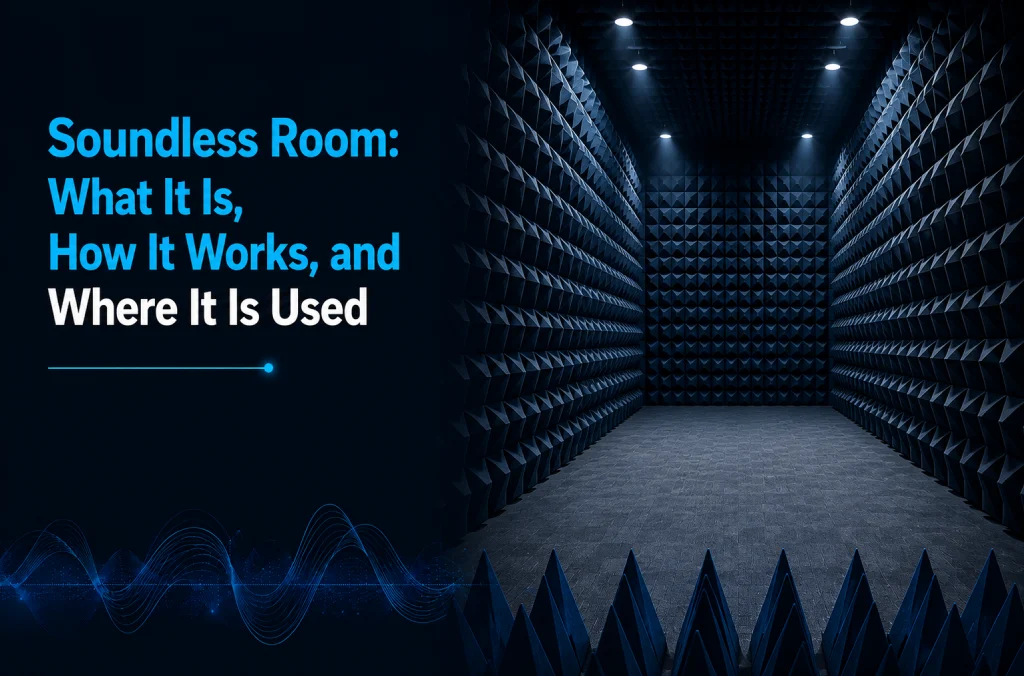
It is specially engineered space designed to absorb sound waves and reduce unwanted reflections. Unlike an ordinary room, its internal surfaces are covered with materials that absorb sound instead of allowing it to bounce back into the testing area.
The purpose is not always to create complete silence. Instead, the goal is to create a controlled environment where the sound being measured is affected as little as possible by echoes, reverberation, or outside noise.
Depending on the testing application, the chamber may be fully anechoic or semi-anechoic. A fully anechoic design uses sound-absorbing materials on the walls, ceiling, and floor, while a semi-anechoic design usually retains a reflective floor for specific types of testing.
Why Is It Called an Anechoic Chamber?
The word anechoic means without echoes.
An anechoic chamber is designed to reduce or eliminate sound reflections inside the testing space. In a conventional room, sound waves repeatedly reflect from hard surfaces. These reflected waves can interfere with direct sound and affect the accuracy of measurements.
Inside an anechoic environment, specially designed absorbers capture much of the sound energy before it can return to the testing area. This creates conditions that are closer to a free-field environment, allowing instruments to measure the source more accurately.
The design and performance of the chamber depend on its intended use, required frequency range, background noise level, and the type of equipment being tested.
How Does a Soundless Room Work?
The working principle is based on two important functions: reducing internal reflections and controlling external noise.
First, the internal surfaces are fitted with acoustic absorbing materials. When sound waves reach these surfaces, much of their energy is absorbed instead of being reflected back into the room.
Second, the structure of the chamber can be designed to reduce the amount of external noise entering the testing area. This may involve insulated wall systems, specialized doors, vibration isolation, and carefully designed openings for cables, ventilation, or equipment.
The overall performance depends on several factors, including:
- Chamber dimensions
- Required frequency range
- Type and thickness of absorbers
- Background noise requirements
- Sound isolation performance
- Testing equipment and setup
Each project may require a different design. For example, testing large automotive components requires different dimensions and absorber configurations than testing small electronic devices.
Materials Used to Absorb Sound and Reduce Reflections
The materials used inside an anechoic chamber play a major role in its performance.
Acoustic absorbers are designed to convert sound energy into small amounts of heat energy, reducing the amount of sound reflected back into the testing area. Common solutions can include fiberglass-based absorbers, mineral wool, acoustic foam, and other specially engineered materials.
Wedge-shaped absorbers are widely used in specialized testing environments. Their shape allows sound waves to travel deeper into the absorbing material, improving absorption over the required frequency range.
The size and thickness of the absorber system are also important. Lower frequencies have longer wavelengths and may require deeper or specially designed absorbing structures. For this reason, material selection should always be based on the technical requirements of the testing application.
In addition to internal absorbers, the outer structure may include high-density panels, insulation systems, acoustic doors, floating floors, and vibration control components to reduce unwanted noise transmission.
Soundproof Room vs. Soundless Room or Anechoic Room
A soundproof room and an anechoic environment are designed for different purposes.
A soundproof room mainly focuses on preventing sound from entering or leaving a space. It is commonly used in recording studios, offices, industrial enclosures, and other areas where noise isolation is important.
An anechoic room, on the other hand, focuses heavily on controlling reflections inside the space. Its internal surfaces are designed to absorb sound and reduce echoes.
In simple terms:
- Soundproofing controls sound transmission between spaces.
- Anechoic design controls reflections within the testing environment.
Some advanced facilities require both high sound isolation and effective internal absorption to achieve reliable testing conditions.
Common Applications
Controlled acoustic environments are used across a wide range of industries.
Acoustic and Product Testing
Manufacturers use specialized chambers to measure the noise produced by products and components. This may include motors, fans, pumps, appliances, speakers, and other equipment.
Testing in a controlled environment allows engineers to identify unwanted noise and evaluate product performance more accurately.
Electronics and Communication Systems
Electronic equipment and communication devices often require controlled testing environments. Depending on the application, specialized chambers can be designed for evaluating antennas, sensors, wireless devices, and other electronic systems.
The exact chamber configuration depends on the testing method and required performance standards.
Automotive Industry
Automotive manufacturers and suppliers use controlled testing facilities to study different sources of vehicle noise.
Applications may include testing:
- Engines and motors
- HVAC systems
- Vehicle interiors
- Speakers and audio systems
- Mechanical components
- Electric vehicle systems
Accurate measurements allow engineers to identify noise sources and improve product design and passenger comfort.
Aerospace and Research
Aerospace, defense, and research organizations may require specialized testing environments for evaluating equipment, components, communication systems, and acoustic performance.
The chamber design must consider equipment size, measurement distance, frequency requirements, safety needs, and applicable testing standards.
Benefits of Using an Anechoic Chamber
One of the main benefits is improved measurement accuracy. By reducing reflections and external interference, engineers can obtain data that more closely represents the actual performance of the tested product.
Another important benefit is repeatability. A controlled environment allows testing to be performed under consistent conditions, which is essential for product development, research, and quality evaluation.
These facilities can also support faster problem identification. Engineers can isolate noise sources, compare product designs, and evaluate improvements without excessive interference from the surrounding environment.
In addition, customized chamber designs can support specific equipment layouts and testing procedures, making them suitable for a wide range of industrial and research applications.
Important Factors to Consider When Designing a Soundless Room
A specialized testing facility should be designed according to its intended application rather than using a standard approach.
1. Testing Requirements
The first step is understanding what will be tested inside the chamber. Acoustic measurements, electronics testing, product evaluation, and other applications may require different configurations.
2. Frequency Range
Frequency range directly affects absorber design and chamber performance. The materials and dimensions should be selected according to the measurement requirements.
3. Chamber Size
The room must provide sufficient space for the product, testing equipment, measurement distance, and operator access. Proper planning can prevent performance limitations and unnecessary construction costs.
4. Background Noise and Isolation
The surrounding environment should be evaluated before installation. Nearby machinery, traffic, HVAC systems, and structural vibrations can affect testing if they are not properly controlled.
5. Equipment Integration
The chamber may need to accommodate microphones, sensors, positioning systems, data acquisition equipment, turntables, or control systems. These requirements should be considered during the design stage.
Looking for a Soundless Room Manufacturer?
Once the testing requirements are clearly defined, working with an experienced manufacturer can make it easier to develop a chamber suited to the intended application.
JV Micronics is a manufacturer, supplier, and provider of customized anechoic chamber solutions for different testing requirements. The company develops chamber systems based on factors such as room dimensions, frequency range, equipment setup, and industry-specific applications.
For businesses and research facilities requiring customized anechoic chamber solutions, including projects and applications in the USA, JV Micronics can provide a tailored approach based on the technical requirements of the testing environment.