Imagine a room so quiet that you can hear your own heartbeat and the blood moving in your ears. That room exists. Microsoft’s anechoic chamber, located at the company’s campus in Redmond, Washington, is one of the quietest places ever measured on Earth. Engineers use it to test how products sound and how well they hear.
This guide explains what the chamber is, how it was built, why it is so quiet, what engineers test inside it and what the experience feels like. Everything is explained in simple terms, so no acoustics background is needed.
What Is Microsoft’s Anechoic Chamber?
Microsoft’s anechoic chamber is an acoustic test room in Building 87 on the Microsoft campus in Redmond, Washington, designed to absorb nearly all sound and block outside noise. In 2015, Guinness World Records recognized it as the quietest place on Earth, with a measured background noise level of about -20.35 dBA.
The word “anechoic” means “without echo.” Inside the chamber, sound waves hit the walls and disappear instead of bouncing back. As a result, you hear only the direct sound from its source. If you are new to the concept, this guide on what an anechoic chamber is and how it works covers the basics.
How Quiet Is Microsoft’s Anechoic Chamber?
Numbers help put this silence into perspective. The decibel (dB) scale measures sound level, and 0 dB is roughly the quietest sound a healthy human ear can detect. A negative reading means the room is quieter than the limit of normal hearing.
| Sound Source | Approximate Level |
|---|---|
| Normal conversation | 60 dBA |
| Quiet library | 30 to 40 dBA |
| Rustling leaves | 20 dBA |
| Human breathing | 10 dBA |
| Threshold of human hearing | 0 dBA |
| Microsoft’s anechoic chamber | About -20 dBA |
That level sits close to the sound of air molecules randomly bumping into each other, known as Brownian motion. In other words, the room approaches the physical limit of silence in normal air.
How Microsoft Built the World’s Quietest Room
Building a room this quiet takes more than thick walls. Microsoft’s design team, led by speech and hearing scientist Hundraj Gopal, combined several layers of protection.
Layered Construction
The chamber uses an “onion” design. Several layers of concrete and steel wrap around the inner room. Each layer blocks more outside noise, such as traffic, air handling and footsteps in the building.
Vibration Isolation
The inner room does not touch the surrounding building directly. Instead, it rests on springs and dampers. These isolate the room from ground vibrations that would otherwise travel through the structure as sound.
Sound-Absorbing Wedges
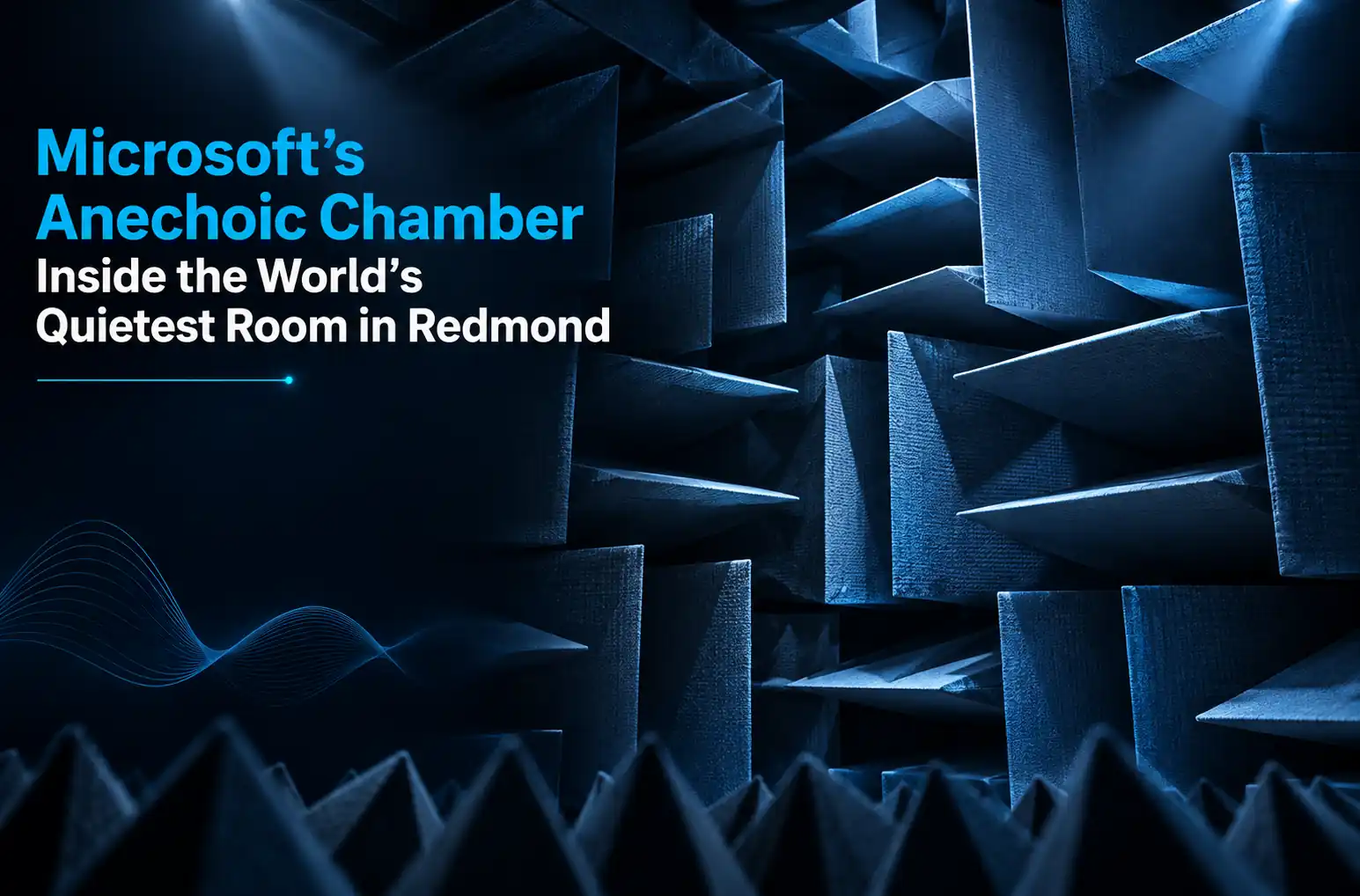
Every wall, the ceiling and the floor are covered with deep, wedge-shaped absorbers. Their tapered shape traps sound waves and turns their energy into a tiny amount of heat. Because the floor is also covered, people walk on a suspended mesh platform above the wedges.
Quiet Building Services
Lighting, ventilation and power lines are designed to add as little noise as possible. Even small hums from equipment could spoil measurements at this level.
What Does Microsoft Test Inside the Chamber?
The chamber is a working lab, not a showpiece. Engineers use it to measure sounds that would be lost in a normal room. Common tests include:
- Keyboards and touchpads: Tuning the click sound so it feels pleasant and consistent.
- Fans and hinges: Finding and reducing small noises in laptops and tablets.
- Microphones: Testing how well devices pick up voice commands and calls.
- Speakers: Measuring sound quality without echoes from walls.
- Human hearing research: Studying how people perceive very quiet sounds.
Because the room removes echoes and background noise, engineers get clean, repeatable data. This helps them design products that sound better in real homes and offices.
What It Feels Like to Stand Inside
Visitors often describe the experience as strange and even uncomfortable. Without background noise, the brain starts to notice sounds from the body. People report hearing:
- Their heartbeat
- Their breathing and swallowing
- A faint ringing in their ears
- Joints creaking when they move
Some people also feel slightly off balance. That happens because we use sound reflections to sense the space around us. When those reflections vanish, the brain loses a familiar cue.
Microsoft’s Anechoic Chamber vs Orfield Laboratories
The Redmond room is often compared with the famous chamber at Orfield Laboratories in Minneapolis. Orfield held the Guinness record before Microsoft’s 2015 measurement, and both rooms are among the quietest spaces in the world. You can read more about that room in this guide to the Minnesota anechoic chamber at Orfield Laboratories.
Different measurement methods and equipment can produce slightly different results. For this reason, both facilities still appear in lists of the world’s quietest rooms. For a wider look at the debate, see this article on where the quietest room in the world is located.
Acoustic Chambers vs RF Anechoic Chambers
Microsoft’s room is an acoustic chamber. It absorbs sound. However, the same “no echo” idea also applies to radio waves.
- Acoustic anechoic chambers use fiberglass or foam wedges to absorb sound waves.
- RF anechoic chambers use carbon-loaded foam and ferrite absorbers inside a shielded metal room to absorb radio waves.
RF chambers support antenna testing, wireless device certification and EMC compliance. Many specialist firms design and build both types of chambers for labs worldwide. If you want to learn about companies in this field, business directories such as a RocketReach company profile list details like location, industry and team size.
Frequently Asked Questions
Where is Microsoft’s anechoic chamber located?
It is in Building 87 on Microsoft’s main campus in Redmond, Washington, USA.
How quiet is Microsoft’s anechoic chamber?
Guinness World Records measured it at about -20.35 dBA in 2015. That level is well below the threshold of human hearing.
Can the public visit Microsoft’s anechoic chamber?
No. The chamber is a private research lab. Access is generally limited to Microsoft staff, invited guests and media visits.
Why do people feel uneasy in an anechoic chamber?
With no background noise or echoes, the brain focuses on internal body sounds. The lack of sound reflections can also affect balance and spatial awareness.
Is Microsoft’s anechoic chamber the quietest room in the world?
It set the Guinness record in 2015. Orfield Laboratories in Minneapolis is also widely cited as one of the quietest rooms, and results depend on how and when each room is measured.
Final Thoughts
Microsoft’s anechoic chamber shows how far engineering can go to control sound. Layered walls, vibration isolation and deep absorbing wedges create a space close to perfect silence. For engineers, that silence is a powerful tool. It reveals the smallest noises and helps create products that sound better in everyday life.