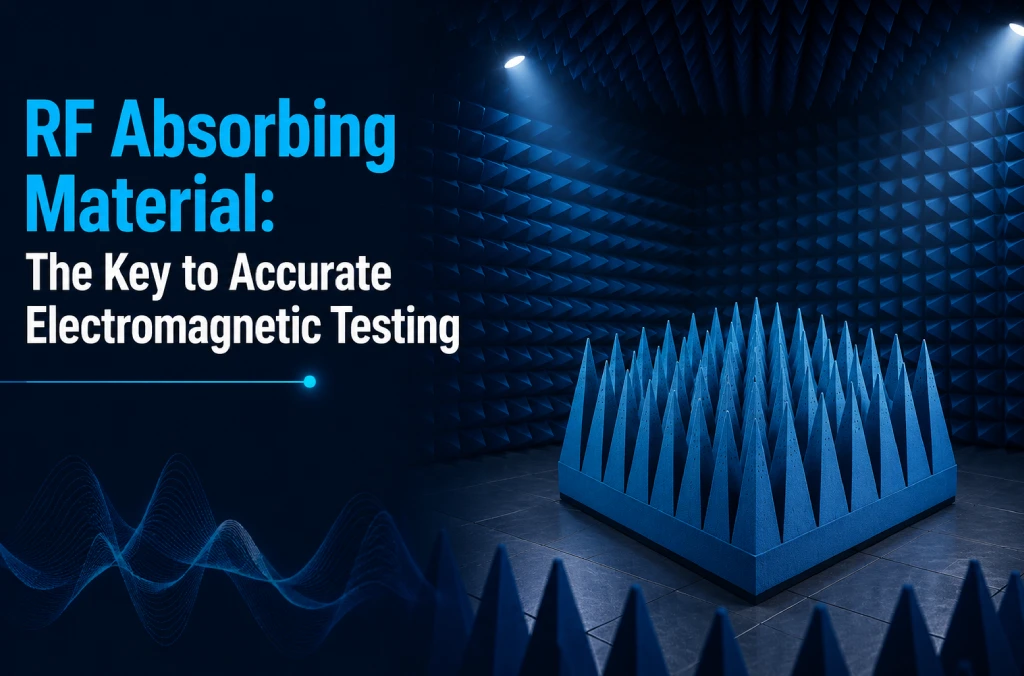
RF Absorbing Material: The Key to Accurate Electromagnetic Testing
In our increasingly connected world, electronic devices are everywhere. From smartphones and medical equipment to automotive radar and aerospace navigation systems, our daily lives rely heavily on wireless communication. However, this explosion of technology creates a major challenge for engineers: electromagnetic interference (EMI) and radio frequency (RF) noise.
When developing or testing electronic components, unwanted background signals and internal reflections can completely distort data, leading to failed compliance tests, delayed product launches, and inaccurate performance metrics.
To overcome these obstacles and achieve true precision in RF testing and electromagnetic compatibility (EMC) compliance, engineers rely on a critical tool: RF absorbing material. These highly engineered materials are specifically designed to capture incident electromagnetic radiation and convert it into a negligible amount of thermal energy, effectively neutralizing reflections.
Whether you are designing a state-of-the-art anechoic chamber, isolating a sensitive military antenna, or eliminating high-frequency noise within a compact electronic enclosure, choosing the correct absorber technology is vital.
As a dedicated RF absorbing manufacturer, JV Micronics designs and provides premium shielding and absorption solutions tailored to meet stringent global testing standards. We help companies establish completely controlled, reflection-free testing environments where accuracy is guaranteed.
The Science Behind Electromagnetic Absorption
To understand why selecting the right material is so important, it helps to understand how it works. When an electromagnetic wave hits a standard surface, like a metal wall or a concrete floor, it bounces off, creating reflections and echoes, much like sound waves bouncing around an empty concrete room. In an RF testing environment, these echoes corrupt the signals being measured.
An RF absorbing material stops this reflection by using specific material physics. These materials are heavily loaded with lossy elements, such as carbon, iron particles, or ferrite crystals. When the electromagnetic wave penetrates the material:
- The wave encounters electric or magnetic dipoles.
- The material resists the movement of these dipoles, creating a “loss” mechanism.
- This resistance converts the RF energy into heat, preventing the wave from bouncing back into the test space.
The goal is to match the electrical impedance of the air to the surface of the material, allowing the wave to enter the absorber seamlessly without reflecting off the front face, and then absorbing it fully as it travels deeper into the structure.
Key Factors to Consider When Selecting RF Absorbing Material
Because different devices operate across wildly different frequencies, there is no single, one-size-fits-all absorber. Choosing the wrong material can result in inadequate attenuation, leading to corrupted data and costly redesigns.
When planning your RF isolation or testing setup, consider these critical technical factors:
1. Target Frequency Range and Performance
The operational frequency of your device under test (DUT) is the single most important factor when choosing an absorber. RF waves vary dramatically in length depending on their frequency.
- Low Frequencies (Megahertz range): These wavelengths are physically long and highly penetrating. To absorb them, you need thick, deep geometric shapes, such as large pyramidal foam absorbers, or high-density magnetic materials like ferrite tiles.
- High Frequencies (Gigahertz and Millimeter-wave range): These wavelengths are much shorter. While traditional foam works well here, advanced modern applications like 5G, 6G, and automotive radar often require specialized, thinner microwave absorbers capable of handling exceptionally high frequencies with extreme precision.
2. Material Structure, Geometry, and Composition
Absorbers are manufactured in several distinct forms, each optimized for different physical layouts and performance goals:
- Pyramidal Foam Absorbers: Made from lightweight polyurethane foam impregnated with carbon, these are shaped into distinct pyramids. The geometric shape creates a gradual impedance transition from the air into the material, providing excellent broadband performance inside large anechoic chambers.
- Ferrite Tiles: These are thin, heavy sintered ceramic tiles containing iron oxides. They excel at absorbing low-frequency waves ($30\text{ MHz}$ to $1\text{ GHz}$) in compact spaces where thick foam pyramids simply will not fit.
- Hybrid Absorbers: By combining ferrite tiles with a layer of foam pyramids on top, you get the best of both worlds: exceptional low-frequency absorption from the ferrite, and high-frequency suppression from the foam.
3. Power Handling and Thermal Dissipation
High-power RF testing, such as testing military radars, base stations, or high-output amplifiers, injects a massive amount of energy into the surrounding environment. Because an RF absorbing material converts this energy into heat, the material itself can heat up significantly during a test.
If the absorber cannot dissipate this heat quickly, it risks losing its performance characteristics, melting, or in extreme cases, becoming a serious fire hazard. It is essential to work with a knowledgeable provider to select materials with high thermal resistance or forced-ventilation compatibility for high-power applications.
4. Environmental and Physical Constraints
The environment where the material will be deployed dictates its physical composition.
- For indoor testing chambers, lightweight, fire-retardant polyurethane foam is the industry standard.
- For rugged industrial applications, outdoor testing fields, or aerospace enclosures, the material may be exposed to humidity, extreme temperatures, fuel, or intense physical vibrations. In these scenarios, silicone-based, rubberized, or epoxy-bound absorbers are utilized because they are non-hygroscopic, chemically stable, and physically durable.
- For tight electronic housings, ultra-thin cavity resonance sheets are preferred to eliminate internal noise without taking up valuable board space.
Why Choose JV Micronics?
When navigating the complexities of electromagnetic shielding and RF suppression, you need a trusted engineering partner rather than just a product supplier. As a leading RF absorbing manufacturer and company, JV Micronics bridges the gap between sophisticated physics and cost-effective, practical implementation.
We don’t believe in generic solutions. Our engineering process is built around delivering reliable, high-performance systems tailored specifically to your unique workflow:
- Precision Manufacturing: We manufacture our absorbers utilizing high-quality raw materials and strict quality control processes. This ensures uniform carbon distribution and precise geometric dimensions, giving you predictable, repeatable performance across every single square meter of coverage.
- Customization Capabilities: Every engineering lab has unique space constraints and distinct testing protocols. We specialize in custom-tailoring form factors, sizes, and specific material formulations to integrate seamlessly into your existing testing setups or product enclosures.
- Comprehensive Systems Expertise: JV Micronics is more than just a component provider; we are a complete solutions company. Because we also design and build customized anechoic chambers and shielding enclosures, we possess an intimate, deep understanding of how absorbing materials interact with shielding panels, turntables, and positioners to maximize overall attenuation and testing reliability.
Conclusion
Selecting and implementing the correct RF absorbing is fundamental to eliminating RF clutter, securing clean data, and successfully achieving regulatory compliance. Because every single application demands a specific frequency response, power rating, and environmental tolerance, off-the-shelf options rarely provide the optimized performance required for precise modern engineering.
If you are looking for a reliable, quality-driven manufacturer and supplier to support your next project, JV Micronics can help you analyze your requirements, select the ideal material composition, and deploy a robust absorption solution that guarantees accuracy.