Weatherproof RF Absorber for Reliable Outdoor RF Applications
RF testing and communication environments are not always located inside controlled laboratory spaces. Many applications require equipment and RF systems to operate outdoors, where they are exposed to changing temperatures, moisture, humidity, dust, and other environmental conditions.
In such environments, standard absorber materials may not provide the durability or long-term performance required for reliable RF applications. This is where a weatherproof RF absorber becomes an important solution.
A weather-resistant absorber is designed to provide RF absorption performance while offering protection against challenging environmental conditions. These materials can be used in outdoor testing environments, antenna applications, RF measurement setups, and other installations where conventional indoor absorbers may not be suitable.
At JV Micronics, we design and manufacture RF solutions based on specific technical and application requirements. Our solutions can support customers looking for durable RF absorber systems for demanding applications across the USA and other global markets.
What Is a Weatherproof RF Absorber?
It is designed to absorb unwanted electromagnetic energy while maintaining performance in environments exposed to outdoor conditions.
Traditional RF absorbing materials are often used inside anechoic chambers and controlled testing facilities. However, outdoor applications may require additional protection against factors such as:
- Rain and moisture
- Humidity
- Temperature variations
- Dust and environmental exposure
- UV exposure
- Long-term outdoor installation conditions
The exact absorber design depends on the frequency range, required reflectivity performance, installation environment, and mechanical requirements.
For this reason, selecting the right RF absorber is not simply about choosing a standard material. The solution must be engineered according to the specific application.
Why Weather Resistance Matters in RF Applications
Outdoor RF systems face environmental challenges that can affect the physical condition and long-term reliability of materials.
A properly designed weather-resistant RF absorber can help maintain stable performance while reducing the impact of environmental exposure. This makes it suitable for applications where RF absorption is required outside traditional indoor laboratory environments.
For organizations looking for RF absorber solutions in the USA, it is important to consider both electromagnetic performance and environmental durability before selecting a material.
The right solution should balance:
- Frequency coverage
- Required reflectivity levels
- Environmental protection
- Mechanical strength
- Installation requirements
- Expected operating conditions
Applications of Weatherproof RF Absorbers
Weather-resistant absorbing materials can be used in a variety of RF and electromagnetic applications.
1. Outdoor RF Testing Areas
Some RF testing applications require open or partially outdoor environments. In these cases, unwanted reflections can affect measurement accuracy.
A RF absorber can help control reflected RF energy while providing greater suitability for environmental exposure.
2. Antenna Test Ranges
Outdoor antenna measurement and testing environments may require RF absorbing materials to minimize unwanted reflections from nearby surfaces or structures.
The absorber configuration can be designed according to the frequency range, antenna setup, and testing requirements.
3. Defense and Aerospace Applications
Certain aerospace and defense applications require specialized RF solutions that can operate in demanding environmental conditions.
Depending on the project requirements, high-performance absorbing materials may be integrated into testing infrastructure or specialized RF environments.
4. Outdoor Communication and RF Infrastructure
RF systems installed in outdoor locations may experience signal reflections and interference from surrounding structures.
RF absorbing materials can be considered as part of a broader RF management strategy where controlling unwanted electromagnetic reflections is necessary.
5. Custom RF Test Facilities
Organizations developing specialized outdoor or semi-outdoor RF test environments may require custom absorber configurations.
An experienced RF absorber manufacturer can evaluate the application and recommend a suitable material design based on technical and environmental requirements.
Weatherproof RF Absorber vs Standard RF Absorbers
The main difference between a weather-resistant solution and a standard RF absorber is the ability to withstand the intended installation environment.
Indoor absorber materials are generally designed for controlled environments. Outdoor applications, however, may require additional protective properties without significantly compromising RF performance.
When selecting an absorber, engineers should evaluate both electrical and physical characteristics.
Important considerations include:
- Frequency range
- Reflectivity requirements
- Power handling capability
- Environmental exposure
- Surface protection
- Installation method
- Long-term durability
A customized approach can be especially valuable when the installation environment has unique requirements.
RF Pyramidal Absorber for High-Performance Applications
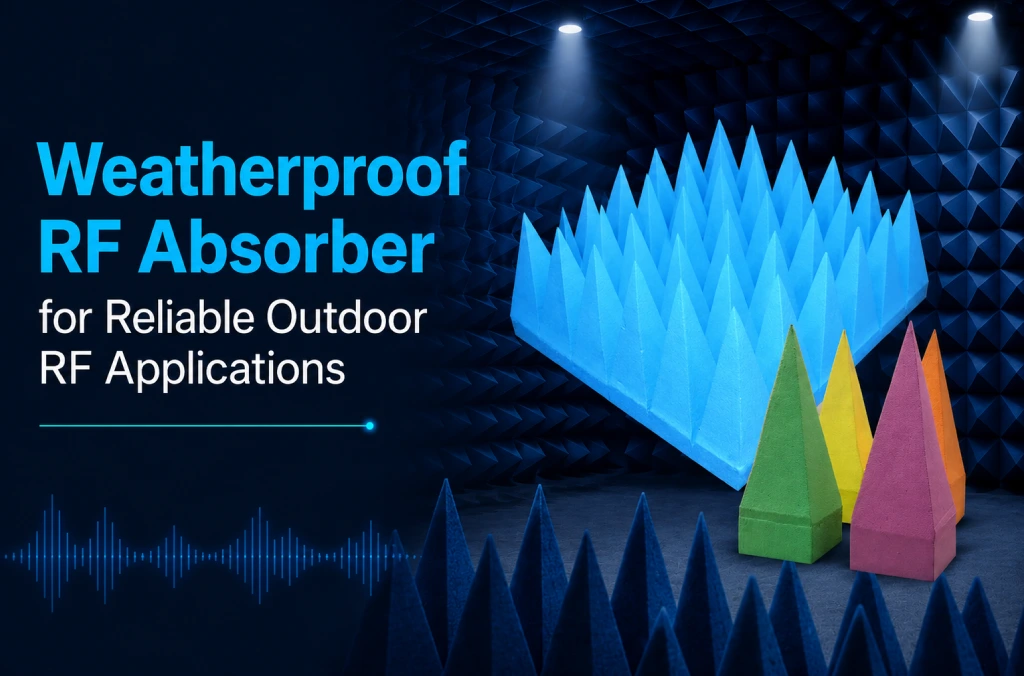
An RF pyramidal absorber is commonly used in anechoic chambers and RF testing facilities to reduce electromagnetic reflections.
The pyramid-shaped design helps create a gradual transition for incoming electromagnetic waves, improving absorption performance across specified frequency ranges.
While pyramidal absorbers are widely used in controlled test chambers, their design and protective construction can also be adapted according to specific environmental and project requirements.
For companies planning anechoic chamber services in the USA or developing advanced RF testing facilities, selecting the correct absorber type is essential for achieving the required testing environment.
The size, shape, frequency performance, and material composition should be selected according to the specific application rather than using a one-size-fits-all approach.
RF High Power Absorber for Demanding RF Environments
Some RF applications involve high levels of electromagnetic energy and require materials capable of handling higher power levels.
An RF high power absorber is designed for applications where power handling capability is an important consideration.
The selection process may involve evaluating:
- Average and peak power levels
- Frequency range
- Thermal management
- Installation conditions
- Required absorption performance
High-power RF applications require careful engineering because excessive energy can generate heat and affect material performance.
Working with an experienced RF absorber supplier helps ensure that the selected solution is appropriate for the expected operating conditions.
The Role of RF Over Fiber Optic in Advanced RF Systems
RF over fiber optic technology can be used to transmit RF signals over optical fiber, providing an alternative to traditional coaxial cable connections in certain applications.
This technology can support RF testing systems where signal transmission distance, electromagnetic isolation, or system architecture are important considerations.
In advanced anechoic chambers and RF testing facilities, RF-over-fiber systems may be integrated with antennas, measurement equipment, and control systems to create a more flexible testing environment.
For organizations developing advanced RF testing infrastructure in the USA, integrating the right combination of absorbers, shielding, measurement systems, and RF signal distribution can help create a solution aligned with project requirements.
Key Factors When Selecting a Weatherproof RF Absorber
Choosing the right weatherproof absorber requires careful technical evaluation.
1. Frequency Range
The absorber should be selected based on the operating or testing frequency range.
Different absorber designs may provide different levels of performance across various frequencies. The required frequency coverage should be clearly defined before finalizing the solution.
2. Environmental Conditions
The installation environment plays an important role.
Factors such as moisture, temperature changes, UV exposure, and dust should be considered when selecting materials and protective construction.
3. Required RF Performance
Every application has different requirements for reflectivity and electromagnetic performance.
The absorber design should support the performance levels required for the specific testing or operational environment.
4. Power Handling Requirements
For high-power applications, thermal and power-handling characteristics must be considered carefully.
An RF high-power absorber may require a different design from a standard RF absorbing material.
5. Installation and Mechanical Requirements
The mounting surface, installation location, maintenance access, and mechanical requirements should also be considered.
A properly engineered installation can contribute to the long-term reliability of the RF absorber system.
Weatherproof RF Absorber Solutions for the USA
Organizations across the USA involved in RF testing, antenna development, aerospace, defense, telecommunications, and electromagnetic research may require specialized RF absorption solutions based on their specific applications.
A standard product may not always meet the required combination of RF performance, environmental durability, and installation requirements.
This is why working with an experienced RF absorber can provide additional value.
At JV Micronics, we support projects with customized RF and microwave solutions designed around technical requirements. Whether the application involves an outdoor RF environment, an advanced anechoic chamber, an RF pyramidal absorber configuration, a high-power RF application, or RF-over-fiber integration, the solution can be evaluated according to the project’s performance requirements.
How JV Micronics Can Help
JV Micronics is an RF absorber manufacturer, supplier, and solution provider supporting customized RF and electromagnetic testing requirements.
We help customers evaluate important project factors such as:
- Application and operating environment
- Frequency range
- Required absorption performance
- Power handling requirements
- Environmental exposure
- Chamber or test area configuration
- Custom integration requirements
Our approach focuses on understanding the technical requirements before recommending or manufacturing a solution.
For businesses looking for weatherproof RF absorber solutions in the USA, JV Micronics can help develop RF absorber systems designed around specific operational and environmental requirements. We also support related requirements involving RF absorbers, RF pyramidal absorbers, high-power RF absorption, anechoic chamber solutions, and RF over fiber optic integration.
Conclusion
A weatherproof RF absorber is an important consideration for RF applications that operate beyond controlled indoor environments.
The right solution must provide the required RF absorption performance while addressing environmental conditions, frequency requirements, power levels, and long-term installation needs.
Since every RF project has different technical requirements, working with an experienced manufacturer can help ensure that the selected absorber solution is designed for the intended application.
JV Micronics provides customized RF absorber and RF testing solutions for organizations seeking reliable, application-focused technology for projects in the USA and beyond.