The microwave absorbing material market is expanding as industries look for better ways to control electromagnetic waves. These engineered materials absorb unwanted microwave energy instead of reflecting it. This can reduce electromagnetic interference, improve signal quality, and lower the radar visibility of equipment.
Demand is rising across defense, aerospace, telecommunications, automotive electronics, and testing facilities. The spread of 5G networks, advanced radar, connected vehicles, and compact electronic devices is creating further opportunities for material suppliers and system designers.
What Are Microwave Absorbing Materials?
Microwave absorbing materials are engineered products that convert electromagnetic wave energy into small amounts of heat. By dissipating the energy, they reduce signal reflection and unwanted interference.
Unlike basic metal shielding, which mainly redirects electromagnetic energy, an absorber manages energy within a device or controlled space. Engineers choose a material according to its frequency range, thickness, weight, temperature resistance, and operating conditions.
Common product forms include:
- Flexible films and elastomers
- Foam absorbers
- Sheets and panels
- Paints and coatings
- Molded components
- Microwave absorbing fabrics
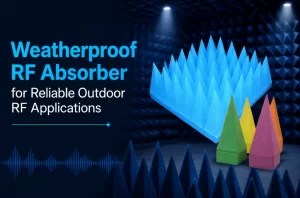
These products are used in radar systems, antennas, electronic housings, vehicles, aircraft, communication equipment, and electromagnetic compatibility test chambers. For application-focused options, explore JV Micronics’ microwave absorber solutions.
Microwave Absorbing Material Market Size and Forecast
Published forecasts indicate steady expansion, although estimates vary because research companies use different market definitions and forecast periods.
Future Market Insights estimates that the market will rise from USD 432.4 million in 2026 to USD 796.5 million by 2036. This represents a compound annual growth rate of 6.3%. Its forecast also identifies films and elastomers as a leading product form and military and defense as a major application area.
Data Bridge Market Research values the market at USD 449.21 million in 2024 and expects it to reach USD 749.04 million by 2032, reflecting a CAGR of 6.6%.
These figures should not be compared as if they use identical methods. However, both forecasts show the same broad direction: demand is growing for materials that manage microwave energy in complex electronic systems.
What Is Driving Market Growth?
The microwave absorbing material market benefits from several connected technology trends.
1. Greater Use of Radar and Defense Electronics
Defense remains an important source of demand. Radar absorbing materials help reduce the radar cross-section of aircraft, ships, vehicles, and other equipment. Modern defense systems also place many electronic components close together. Absorbing sheets, coatings, and composites help control internal interference while supporting reliable sensing and communication.
2. Growth of Automotive Radar
New vehicles use radar for automatic emergency braking, adaptive cruise control, blind-spot detection, and parking support. These sensors must identify objects accurately despite nearby electronic noise.
Thin absorbers placed inside radar modules can reduce unwanted reflections and improve signal clarity. Demand could rise further as advanced driver-assistance systems become standard across more vehicle categories.
3. Expansion of 5G and Wireless Infrastructure
Higher-frequency communication systems require careful control of electromagnetic interference. Absorbers support antenna testing, base-station equipment, device enclosures, and other radio-frequency components.
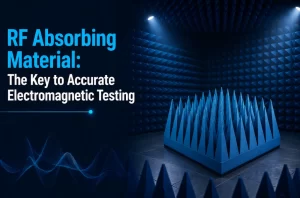
They are also widely used inside anechoic chambers. These controlled spaces absorb reflected waves and allow engineers to test antennas, wireless devices, and communication systems accurately. Learn more about how RF absorbing material supports accurate electromagnetic testing.
4. Smaller and More Powerful Electronics
Electronic products continue to shrink while processing more data. Compact layouts place antennas, processors, sensors, and wireless modules close together. Flexible absorber films and custom-cut components provide a practical way to manage electromagnetic noise without making a device much larger.
Key Material and Product Segments
The microwave absorbing material market can be divided by material, product format, frequency band, and application.
Carbon-Based Absorbers
Carbon-based products may contain carbon black, carbon fibers, carbon nanotubes, or graphene-related materials. They are attractive because they can provide broad frequency coverage while keeping weight relatively low.
Ferrite-Based Absorbers
Ferrites use magnetic properties to absorb electromagnetic energy. They can perform well in selected frequency ranges and often appear in tiles, sheets, composites, and electronic noise-control parts. However, their weight or thickness can limit use in some mobile and aerospace systems.
Conductive Polymers and Hybrid Composites
Conductive polymers offer flexibility, low weight, and useful processing options. Hybrid materials combine carbon, ferrite, magnetic particles, polymers, or other fillers to balance performance. This approach allows developers to target a frequency band while improving strength, flexibility, or heat resistance.
Coatings, Films, Foams, and Molded Parts
- Coatings cover complex or irregular surfaces.
- Films and elastomers fit compact or curved electronic parts.
- Foams and panels reduce reflections in test chambers.
- Molded components fit directly into sensor housings or devices.
- Fabrics support flexible and wearable applications.
Leading Applications in the Microwave Absorbing Material Market
Military and defense applications account for a significant part of demand, but commercial uses are becoming more important. Major applications include:
- Radar signature reduction
- Aerospace communication and navigation systems
- Automotive radar modules
- 5G and telecommunications equipment
- Consumer and industrial electronics
- Antenna and EMC testing
- Medical imaging and diagnostic equipment
The best solution depends on the target frequency, available installation space, operating temperature, weight limit, and required durability.
Regional Market Outlook
North America holds a strong position due to its established aerospace, defense, electronics, and testing sectors. Asia-Pacific also presents significant growth potential. China, Japan, South Korea, and India have large electronics, automotive, telecommunications, and defense industries.
Europe continues to generate demand through automotive radar, aerospace engineering, defense programs, and industrial electronics. Local technical support and clear qualification data can help suppliers compete in every region.
Major Industry Trends
Innovation within the microwave absorbing material market focuses on products that are thinner, lighter, and more effective.
Lightweight and Broadband Materials
Users increasingly want one product to absorb energy across a wider frequency range. Broadband performance can reduce design complexity and support equipment operating through several communication bands.
Nanomaterials and Metamaterials
Nanostructured fillers may improve absorption without adding excessive weight. Metamaterials use carefully designed structures to control electromagnetic behavior. These approaches can support thin and tunable absorbers, although production cost and manufacturing scale remain concerns.
Customized Frequency Performance
A product that performs well at one frequency may perform poorly at another. Suppliers are therefore developing solutions for specific radar, 5G, millimeter-wave, and testing needs. Customization may involve changing the composition, thickness, surface structure, or shape.
More Sustainable Products
Manufacturers are exploring bio-based polymers, recyclable components, and production methods with a lower environmental impact. Sustainable products must still meet strict absorption, durability, and safety requirements.
Market Challenges and Business Opportunities
The microwave absorbing material market faces several barriers:
- High prices for advanced materials
- Complex manufacturing methods
- Long qualification cycles in defense and aerospace
- Performance changes caused by heat, moisture, or mechanical stress
- Difficulty maintaining consistent absorption across broad frequencies
- Limited standardization between applications
These challenges also create opportunities. Suppliers can stand out through clear test data, repeatable quality, custom shapes, and practical technical support. Strong prospects exist in scalable coatings, thin automotive radar absorbers, broadband chamber products, and lightweight aerospace composites.
Competitive Landscape
Competition involves global material companies and specialist absorber manufacturers. Companies identified across industry research include Parker Hannifin, 3M, Rogers Corporation, TDK Corporation, Laird Technologies, ESCO Technologies, ARC Technologies, Cuming Microwave, and Mast Technologies.
Buyers usually assess absorption performance, frequency coverage, thickness, weight, environmental resistance, manufacturing consistency, delivery reliability, and qualification support. Price matters, but proven application performance often carries greater weight.
Future Outlook
The microwave absorbing material market has a positive long-term outlook. Defense modernization will remain important, while automotive radar, wireless communication, satellite systems, and compact electronics should broaden the customer base.
Future products will likely combine high absorption, low weight, thin construction, and stable performance. Suppliers that move advanced designs from laboratory research into affordable large-scale production will hold a clear advantage.
Frequently Asked Questions
What is a microwave absorbing material?
It is an engineered material that absorbs microwave energy and converts part of it into heat. This reduces reflections, radar visibility, and electromagnetic interference.
What drives demand for microwave absorbing materials?
Important drivers include defense radar, 5G infrastructure, automotive sensors, aerospace electronics, and the need to control interference inside compact devices.
Which materials are commonly used?
Common choices include carbon-based materials, ferrites, conductive polymers, dielectric materials, magnetic composites, and hybrid nanomaterials.
What is the difference between EMI shielding and microwave absorption?
EMI shielding often reflects electromagnetic energy away from a device. Microwave absorbers take in and dissipate the energy. Many systems use both methods together.
Which industries offer the greatest opportunities?
Defense, telecommunications, automotive radar, aerospace, satellite communication, electronics testing, and advanced consumer devices are expected to offer strong opportunities.