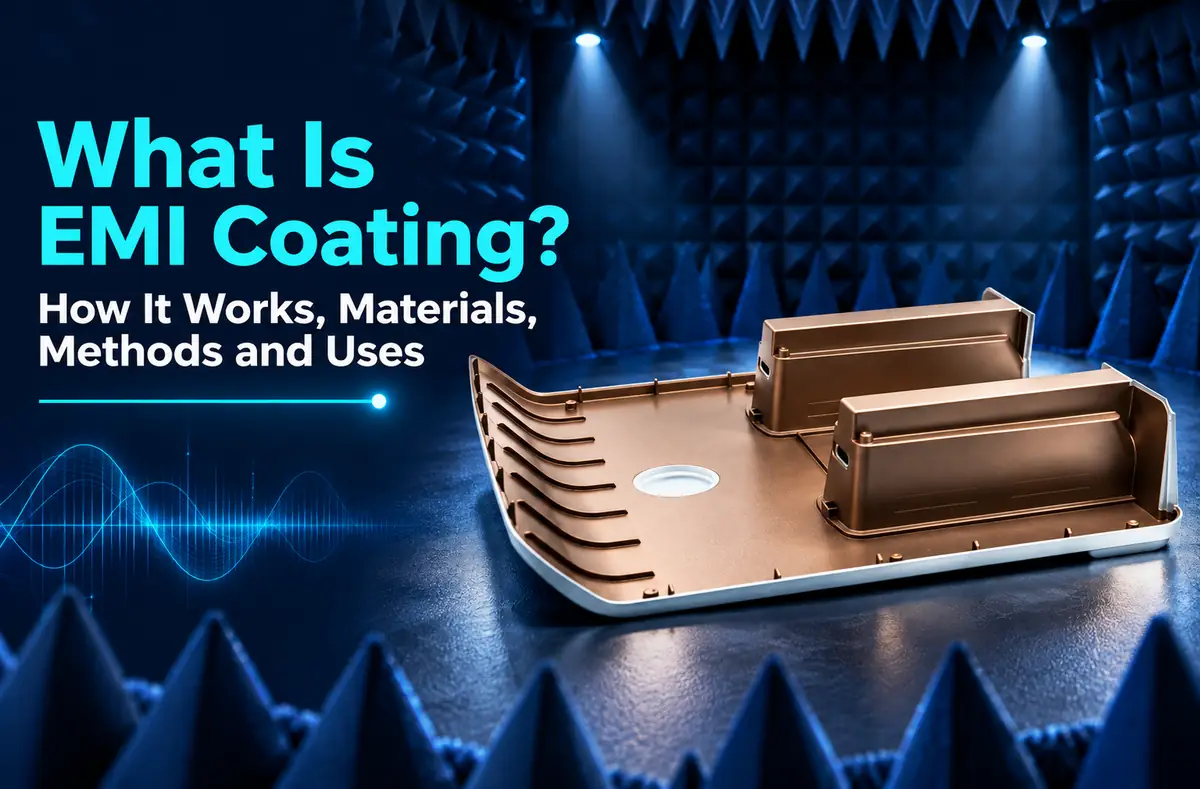
Phones, pacemakers, car sensors and satellite radios all share one hidden enemy: electromagnetic interference. So, what is EMI coating, and why do so many products depend on it? In short, it is a thin conductive layer applied to a device’s housing that blocks unwanted electromagnetic energy from getting in or out.
This guide explains how EMI coating works, the main coating methods, the metals used, where it is applied and what to check before choosing a coating. The goal is to keep things simple, even if you are new to electronics.
What Is EMI Coating?
EMI coating is a thin layer of conductive material, usually metal, applied to the surface of a plastic or composite enclosure to shield electronics from electromagnetic interference. It turns a non-conductive plastic case into a protective shield. As a result, the device stays stable and does not disturb other nearby electronics.
EMI stands for electromagnetic interference. It is any unwanted electromagnetic energy that disrupts a circuit. You may also hear the term RFI, or radio frequency interference. RFI is a subset of EMI that covers the radio part of the spectrum. A good EMI coating helps with both.
Why Electronics Need EMI Protection
Interference comes from many places. Some sources are natural, such as lightning and solar activity. However, most interference today comes from other electronics, including:
- Switching power supplies and chargers
- Electric motors and drives
- Wireless transmitters, Wi-Fi and cellular radios
- Fast digital circuits and processors
When interference reaches a sensitive circuit, it can cause noise, data errors, dropped signals or complete failure. That is why regulators set limits on how much energy a product can emit and how much it must tolerate.
Metal housings shield well, but they are heavy and costly to shape. Plastic housings are light and cheap, but they let EMI pass straight through. EMI coating gives you the best of both: a light plastic body with a metal-like shielding surface.
How Does EMI Coating Work?
An EMI coating protects electronics in three main ways:
- Reflection: The conductive surface bounces most incoming waves away from the device.
- Absorption: Some energy enters the coating and turns into a small amount of heat.
- Grounding: The coating connects to the circuit ground, so induced currents flow safely away from sensitive parts.
Engineers measure performance as shielding effectiveness (SE), shown in decibels (dB). Every 20 dB cuts the field strength by a factor of ten. So, 60 dB reduces field strength to one-thousandth of its original level. Many commercial products need somewhere between 40 and 80 dB, while some military systems require much more.
Common Materials Used in EMI Coating
A common follow-up to “what is EMI coating?” is “which metal should I use?” The metal you choose shapes how the coating performs. Each option has strengths and trade-offs.
| Material | Key Strength | Best Suited For |
|---|---|---|
| Copper | Very high conductivity | High frequencies, telecom, computing |
| Aluminum | Light weight, natural oxide layer | Aerospace and portable devices |
| Nickel | Magnetic properties, corrosion resistance | Low frequencies, harsh environments |
| Silver | Excellent conductivity and stability | High-performance and critical devices |
Here is a simple rule to remember. High-conductivity metals like copper work best against high-frequency waves. Magnetic metals like nickel work best against low-frequency magnetic fields. For this reason, many coatings stack two or more metals, such as copper under nickel, to cover a wider frequency range and resist corrosion. For a deeper look at shielding options beyond coatings, read this guide on EMI shielding materials.
Main EMI Coating Methods
Engineers who ask “what is EMI coating?” quickly learn there is more than one way to put metal on plastic. The best method depends on part shape, volume, cost and required performance.
Vacuum Metallization
In vacuum metallization, metal is heated inside a vacuum chamber until it vaporizes. The vapor then settles on the part as a thin, even film. Some systems deposit several metal layers in one cycle. This method suits complex shapes and high production volumes.
Conductive Paint
Conductive paints contain fine particles of silver, copper or nickel mixed into a binder. Workers spray them onto the inside of the enclosure. This approach is flexible and works well for low to medium volumes.
Electroless Plating
Electroless plating uses a chemical bath to deposit metal, often copper followed by nickel, without electric current. It creates a uniform coating, even inside deep corners.
Sputtering and Thermal Spray
Sputtering knocks metal atoms off a target so they coat the part. Thermal or arc spray melts metal and sprays it onto the surface. Both methods suit specialized applications.
Key Design Factors to Consider
A coating only performs well when the full design supports it. Keep these points in mind:
- Frequency range: Match the metal and thickness to the interference you need to block.
- Seams and gaps: Leaks often happen at joints, lids and openings, not through the coating itself.
- Grounding contact: The coating must connect firmly to the ground plane.
- Masking: Some areas, such as labels, contacts or mounting surfaces, must stay uncoated.
- Adhesion: Proper surface cleaning stops peeling during heat cycles and vibration.
- Environment: Humidity, salt spray, chemicals and temperature swings affect material choice.
After coating, the product still needs testing to prove it meets emission and immunity limits. This overview of the EMI testing procedure explains how that testing works step by step.
Where Is EMI Coating Used?
EMI coating appears in almost every industry that relies on electronics:
- Aerospace: Avionics and navigation units that must meet standards such as RTCA DO-160.
- Defense: Rugged radios and control systems built to standards such as MIL-STD-461.
- Medical: Patient monitors, diagnostic tools and wearable devices. Learn why this matters in medical device EMC testing.
- Automotive: Control units, radar sensors and EV charging electronics.
- Telecom and IoT: 5G modules, base station parts and smart sensors.
- Industrial: PLCs, motor drives and factory automation controls.
How to Choose an EMI Coating Partner
If you plan to outsource coating work, compare vendors carefully:
- Ask for measured shielding effectiveness data on similar parts.
- Check which coating methods and metals they offer.
- Confirm they can handle your volume, from prototypes to full production.
- Review quality certifications that apply to your industry.
- Research the company’s background. Business directories such as a RocketReach company profile show basic details like location, industry and team size.
Frequently Asked Questions
What is EMI coating used for?
EMI coating shields electronic devices from outside interference. It also stops a device’s own emissions from disturbing nearby equipment. Common uses include phones, medical devices, avionics, vehicles and industrial controls.
What is EMI coating made of?
Most coatings use conductive metals such as copper, aluminum, nickel or silver. They are applied as a vacuum-deposited film, a plated layer or a metal-filled paint.
What is EMI coating thickness?
Coatings are usually very thin, often measured in microns. The right thickness depends on the metal, the method and the frequencies involved. At high frequencies, extra thickness adds little benefit because of the skin effect.
What is EMI coating performance measured in?
Performance is measured as shielding effectiveness in decibels (dB). A higher number means stronger protection. For example, 40 dB cuts field strength by 100 times, while 60 dB cuts it by 1,000 times.
Is EMI coating the same as EMI shielding?
Not exactly. EMI shielding is the broad goal of blocking interference. EMI coating is one method to achieve it. Other shielding methods include metal cans, gaskets, conductive fabrics and shielded rooms.
Can EMI coating be applied to any plastic?
Most engineering plastics accept EMI coatings, including ABS, polycarbonate and blends of both. However, the surface needs proper cleaning and preparation for strong adhesion.
Final Thoughts
So, what is EMI coating in simple terms? It is a thin metal skin that turns a light plastic housing into a reliable electromagnetic shield. By choosing the right metal, method and design details, engineers protect sensitive electronics, meet compliance limits and keep products working as intended.